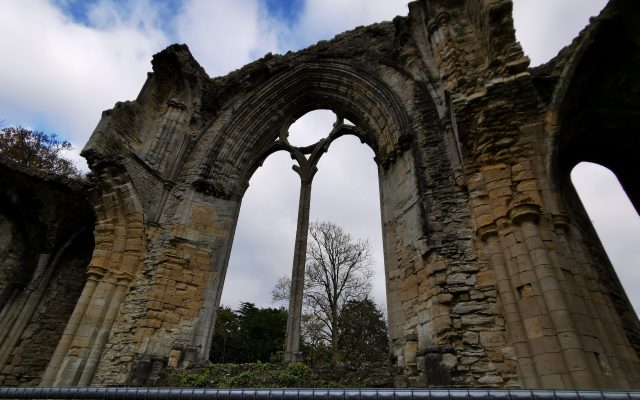
When we think of Jane Austen, we usually picture grand country houses, elegant ballrooms in Bath, and walks through manicured Georgian estates. But the beloved author of Pride and Prejudice had a darker, more romantic inspiration right on her doorstep: the haunted, roofless ruins of Netley AbbeyClick to open side panel for more information.
If you have ever read Austen’s brilliant Gothic satire Northanger Abbey, you have already felt the shadowy influence of Netley. Here is the story of how Hampshire’s most famous ruin captured the imagination of England’s greatest novelist.
The Austen Family in Southampton
To understand Austen’s connection to the abbey, we have to look at a difficult period in her life. Following the death of her father in 1805, Jane, her mother, and her sister Cassandra were in a precarious financial position. They eventually moved to Southampton to live with Jane’s brother Francis (a naval officer) and his wife.
While living in Southampton between 1806 and 1809, Jane was deeply familiar with the local landscape. In the late 18th and early 19th centuries, Netley Abbey wasn’t the neatly manicured English Heritage site we see today. It was wild, entirely overgrown with thick ivy, and framed by dense woods. To get there, the Austens would often have to take a boat ride down the River Itchen.
A Romantic Water Party
We know for a fact that Jane visited the abbey. In October 1808, Jane wrote a letter to her sister Cassandra describing a “water party” (a boat trip) she took with her young nephews to visit the ruins.
Austen reportedly described the abbey as an “old ruinous place but very romantic and command[ing] a most delightful view.”
This wasn’t just a casual family picnic. In the Georgian era, visiting Netley Abbey was the ultimate “Dark Academia” tourist experience. The ruins were already famous for the terrifying legend of Walter Taylor (the builder crushed to death by a falling window in 1704), and rumor had it that the ghosts of monks still walked the cloisters.
For a brilliant, observant writer like Austen, standing in the eerie, ivy-choked nave of Netley was pure creative fuel.
The Northanger Abbey Connection
It is widely believed by literary historians that Netley Abbey directly influenced Austen’s novel Northanger Abbey (which was published posthumously in 1817).
Northanger Abbey is a brilliant satire of the “Gothic” horror novels that were wildly popular in Austen’s day. The heroine, Catherine Morland, is a teenager obsessed with reading spooky books about haunted castles and sinister monks. When Catherine is invited to stay at an actual former abbey (the fictional Northanger), her overactive imagination runs wild, and she begins to suspect the owner of terrible crimes.
Austen’s real-life experiences walking through the shadows of Netley Abbey allowed her to perfectly capture the creepy, awe-inspiring atmosphere of a ruined monastery. But it also allowed her to satirize the exact kind of “ruin tourists” who flocked to Netley looking for ghosts in the bushes.
Furthermore, Austen uses Northanger Abbey to quietly criticize the greedy landowners who took over these sacred monastic buildings during the Reformation just to get rich—a fate that exactly mirrors what happened to Netley when it was given to Sir William Paulet by Henry VIII.
Follow in Jane’s Footsteps
Today, Netley Abbey has been cleared of its wild ivy, but the soaring Gothic arches that captured Jane Austen’s imagination are still standing.
If you are a fan of classic literature, there is nothing quite like standing in the very spot that helped inspire one of the greatest novels in the English language.